Best Content Strategy for Dental Practice 2026: SEO, AEO and AI Visibility Guide
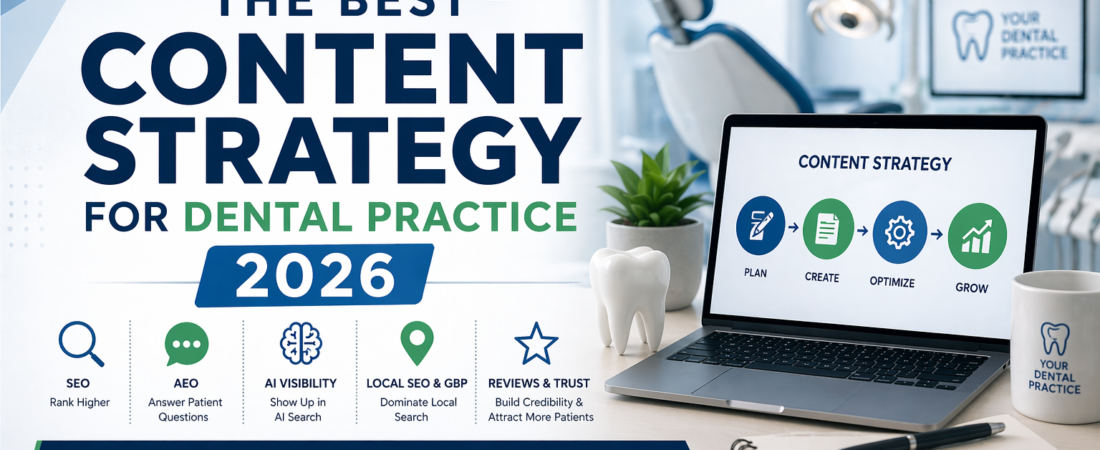
TL;DR: The best content strategy for dental practice 2026 combines SEO, AEO, GEO, Google Business Profile optimization, blog content, reviews, internal linking, and authority building. Dental practices that answer real patient questions clearly are more likely to rank in Google, appear in AI-generated answers, and earn trust before a patient ever calls.
The best content strategy for dental practice 2026 is no longer just about writing occasional blog posts and hoping Google ranks them. Today, dental practices need a complete content system built for SEO, AEO, GEO, Google Business Profile visibility, local trust, patient education, and AI search.
Patients are changing how they search. Many still use Google, but they are also asking tools like ChatGPT, Perplexity, voice assistants, and Google AI Overview for recommendations. Because of this shift, dental content must be structured clearly enough for search engines, answer engines, and AI systems to understand, extract, and trust.
In this guide, you will learn how to build a modern dental content strategy that helps your practice get found, earn trust, support local search, and compete in the new AI-driven search landscape. More importantly, you will see why outdated dental content is no longer enough to attract patients in 2026.
Need help creating better dental content? Visit our Dental Marketing Services page to see how we help dental practices improve SEO, AEO, GEO, content strategy, and AI visibility.
What Is the Best Content Strategy for Dental Practice 2026?
The best content strategy for dental practice 2026 is a structured system that combines website content, blog content, Google Business Profile updates, local SEO, patient FAQs, reviews, internal linking, outbound authority signals, and AI search optimization. The goal is to make your practice easier for Google, AI tools, and patients to understand.
This means your dental website cannot be thin, outdated, or generic. It must clearly explain who you help, what services you offer, where you serve patients, what questions you answer, and why your practice should be trusted. In addition, your content must be organized in a way that supports both traditional Google rankings and AI-generated answers.
A strong dental content strategy should include:
- Optimized homepage content
- Service pages for each major treatment
- Location pages for local search visibility
- Educational blog posts answering patient questions
- FAQ sections written for answer engines
- Google Business Profile posts and updates
- Review-building and reputation signals
- Internal links that connect related pages
- Outbound authority links where helpful
- Schema markup for search engines and AI systems
Key Takeaway: Dental content in 2026 must do more than rank. It must answer, explain, convert, and help AI systems understand why your practice deserves visibility.
Why Did Dental Content Strategy Change in 2026?
Dental content strategy changed because patients now search with longer questions, voice prompts, AI tools, and comparison-based queries. That means dental practices need content that gives direct answers, shows trust, and matches how people actually make decisions.
Dental content strategy changed because patients no longer rely only on traditional Google searches. Instead, they ask longer, more specific questions across Google, voice search, AI tools, Reddit, Quora, and other platforms. As a result, dental practices need content that matches real patient questions and search behavior.
For example, patients may search:
- What is the best dentist near me for anxious patients?
- How much does Invisalign cost in my area?
- What should I do if I have a dental emergency?
- Is a root canal painful?
- How do I choose a family dentist?
These searches are conversational, specific, and intent-driven. Therefore, your content must sound natural, answer directly, and include enough detail to satisfy both people and search systems.
Also, AI systems often summarize answers from multiple sources. If your content is vague, buried, or poorly structured, it may never be selected. However, if your content uses clear headings, direct answers, helpful lists, and strong trust signals, it becomes easier for AI tools to understand and reference.
How Does SEO Fit Into the Best Content Strategy for Dental Practice 2026?
SEO helps dental practices get found in Google by matching patient searches with relevant content, services, locations, and trust signals. It is still the foundation of visibility, but it must now work together with AEO and GEO.
SEO helps your practice appear in Google search results when patients search for dental services, local dentists, emergency care, cosmetic dentistry, implants, cleanings, and other high-intent topics.
However, SEO in 2026 is not just about placing keywords on a page. It requires topical authority, internal linking, useful content, location relevance, technical structure, and patient-focused answers. In other words, Google needs to see that your site is genuinely helpful and organized around real dental topics.
Important dental SEO content includes:
- Dental service pages
- Local SEO pages
- Patient education blogs
- Insurance and payment information
- Emergency dental care content
- Before-and-after explanation pages
- FAQs about common procedures
For stronger internal structure, connect your blog posts to related service and location pages. For example, your content should link naturally to pages like SEO for Dentists, Optimized Blog Content for Dentists, and Dental Marketing Blog.
Key Takeaway: SEO helps your dental practice get found, but it works best when supported by strong content structure, local relevance, internal links, and patient-focused answers.
How Does AEO Help Dental Practices Get Found in Answer Engines?
AEO helps dental content get chosen as a clear answer when patients ask search engines, voice assistants, or AI tools direct questions. It works best when each section starts with a short, specific answer before expanding into details.
AEO, or Answer Engine Optimization, helps your dental content get selected as a direct answer. This matters because people now search with full questions instead of short keywords.
For example, instead of searching only “dental implants,” a patient may ask, “How long do dental implants last?” or “Are dental implants worth it?” Your content should answer those questions clearly at the beginning of each section.
Good AEO content uses:
- Question-based headings
- Short direct answers after each heading
- Simple explanations
- Bullet points and numbered steps
- FAQ sections
- Definitions of dental terms
This structure helps Google AI Overview, ChatGPT, Perplexity, and voice assistants understand the content quickly. It also improves the reader experience because patients do not have to dig through long paragraphs to find the answer.
How Does GEO Help Dental Practices Show Up in AI Search?
GEO helps AI systems understand, trust, and summarize your dental practice by connecting your website content with reviews, listings, social signals, and third-party authority. This matters because AI tools often evaluate more than your website alone.
GEO, or Generative Engine Optimization, helps dental practices become more visible in AI-generated answers. While SEO focuses on rankings, GEO focuses on whether AI systems understand, trust, and mention your practice or content.
AI tools often evaluate signals beyond your website. They may look at reviews, business listings, local mentions, directory profiles, social content, and other online references. Therefore, your dental practice needs a wider web presence.
Helpful GEO trust sources include:
- Google Business Profile
- Yelp
- Healthgrades
- Zocdoc
- Local directories
- Dental association listings
- Community mentions
- Social media profiles
In addition, your website should clearly state your services, location, expertise, and patient benefits. When AI systems can connect your website, reviews, directory listings, and content together, your authority becomes easier to recognize.
Key Takeaway: GEO helps your dental practice become easier for AI systems to understand, trust, summarize, and recommend.
Which Core Pages Should a Dental Content Strategy Include?
A dental content strategy should include a homepage, about page, service pages, location pages, blog, FAQ page, and contact page. These pages create the foundation Google and AI tools use to understand what the practice offers and who it serves.
Your core website pages form the base of your dental content strategy. Without strong core pages, your blogs, Google Business Profile posts, and local SEO efforts have less support.
At minimum, a dental practice website should include:
- Homepage
- About page
- Contact page
- Services overview page
- Individual dental service pages
- FAQ page
- Blog page
- Location or service area pages
Each page should have a clear purpose. Your homepage should communicate trust and guide visitors to action. Your service pages should explain treatments in detail. Your FAQ page should answer common patient questions. Your blog should build authority around dental topics and patient concerns.
Helpful internal pages to connect include About Dental Marketing Content, Dental Marketing FAQs, Contact Dental Marketing Content, and Dental Marketing Services.
How Does Blog Content Support Dental SEO, AEO and GEO?
Blog content supports dental SEO, AEO, and GEO by answering patient questions, building topical authority, and giving search engines more helpful content to index. It also creates natural opportunities to link to services, location pages, and FAQs.
Blog content helps dental practices build topical authority. It gives your website more opportunities to answer patient questions, target long-tail keywords, and support service pages with internal links.
The best dental blog topics usually come from real patient concerns. These topics may include pain, cost, fear, timelines, insurance, recovery, treatment options, and emergencies.
Strong dental blog topic examples include:
- How do I know if I need a root canal?
- What should I do if my tooth breaks?
- How much does teeth whitening cost?
- What is the best option for missing teeth?
- How often should I see a dentist?
- What is the difference between veneers and bonding?
These topics work because they match how real people search. They also create content that AI systems can extract when answering questions about dental care.
Want help building dental blog authority? Learn more about our Optimized Blog Content for Dentists service.
Why Does Google Business Profile Content Matter in 2026?
Google Business Profile content matters because it helps Google understand your services, activity, location, photos, reviews, and patient engagement. An active profile can support local visibility, Maps performance, and patient trust.
Google Business Profile content is critical for local dental visibility. Your profile helps Google understand your services, location, activity, reviews, photos, and patient engagement.
Many dentists claim their profile but rarely update it. That is a mistake. An active Google Business Profile can support Maps visibility, local search rankings, and patient trust.
Weekly Google Business Profile content can include:
- Dental tips
- Service highlights
- Office updates
- Team photos
- Patient education posts
- Seasonal reminders
- FAQ-style posts
- Promotions or limited-time offers
Your profile should also include accurate categories, complete services, updated hours, real photos, and consistent review responses. For deeper support, visit our Google Business Profile Optimization for Dentists page.
How Do Reviews Fit Into a 2026 Dental Content Strategy?
Reviews support dental content strategy because they show trust, patient experience, service quality, and real-world proof. They also help reinforce the words patients use when describing your practice, such as gentle dentist, emergency appointment, family dentist, or affordable dental care.
Reviews are a major trust signal for both patients and search systems. They help people decide whether to call your office, and they also help Google understand your reputation.
In 2026, reviews should not be treated as separate from content. Instead, reviews should support your content strategy because they contain real patient language. For example, if patients mention “gentle dentist,” “emergency appointment,” “great with kids,” or “affordable dental care,” those phrases help reinforce what your practice is known for.
Dental practices should:
- Ask for reviews consistently
- Respond to every review professionally
- Look for keyword patterns in reviews
- Use patient questions to inspire blog topics
- Build trust through real feedback
Never copy private patient information or make unsupported claims. However, you can use general themes from reviews to understand what patients value most.
What Long-Tail Keywords Should Every Dental Practice Consider?
Dental practices should target long-tail keywords that match real patient questions, local search intent, cost concerns, treatment comparisons, and AI-style queries. These phrases are usually more specific and often reveal stronger intent.
Long-tail keywords are longer, more specific phrases that often show stronger intent. They are important because patients use natural language when searching online and asking AI tools questions.
Examples of long-tail dental content keywords include:
- best content strategy for dental practice 2026
- how to market a dental practice in 2026
- dental content marketing strategy for dentists
- how dentists get patients from AI search
- how to rank a dental website in Google AI results
- why dentists are not showing up in ChatGPT
- best local SEO strategy for dental offices
- Google Business Profile content ideas for dentists
- blog topics for dental practices
- how to get more dental patients without only using ads
These phrases help you reach dentists and patients who are searching with specific intent. They also make your content more useful for AI extraction because the language matches real questions.
How Do You Build the Best Content Strategy for Dental Practice 2026?
You build the best content strategy for dental practice 2026 by auditing weak pages, improving core service content, adding FAQs, publishing blogs, updating Google Business Profile, building reviews, and refreshing content consistently. Each step should support patient trust and search visibility.
A complete dental content strategy should be built in layers. First, you need strong website pages. Next, you need educational blog content. Then, you need Google Business Profile updates, review growth, local authority, social content, and ongoing content refreshes.
A simple content system may look like this:
- Audit the website and identify weak pages.
- Improve homepage messaging and calls to action.
- Create or expand service pages.
- Add FAQ sections to major pages.
- Publish two to four blog posts per month.
- Post weekly to Google Business Profile.
- Build internal links between related pages.
- Refresh older content every three to six months.
- Track rankings, calls, forms, and patient questions.
- Use new search data to create future content.
This system helps your dental practice build momentum over time. Instead of publishing random content, every page supports a larger visibility plan.
Key Takeaway: The strongest dental content strategy is not random. It is planned, connected, updated, and built around what patients actually ask before choosing a dentist.
Why Does a Dental Practice Content Strategy Fail in 2026?
A dental practice content strategy usually fails when pages are too thin, service content is generic, Google Business Profile is inactive, reviews are weak, and content is not structured for AI answers. These gaps make it harder for Google, patients, and AI tools to trust the practice.
Many dental practices struggle online because their content is too thin, too generic, or too outdated. A website with five basic pages may not be enough anymore, especially in competitive areas where other practices are publishing detailed service pages, blogs, FAQs, and Google Business Profile updates.
Your content strategy may fail if:
- Your service pages are too short
- Your website does not answer patient questions
- Your Google Business Profile is inactive
- Your blog has not been updated in months
- Your site has weak internal linking
- Your reviews are not growing
- Your content is not structured for AI answers
- Your pages do not clearly explain location relevance
Every day your practice is not visible in Google search, Google Maps, and AI-powered answers, potential patients may choose another office. That is why content is not just a marketing task. It is part of your patient acquisition system.
Need a stronger dental visibility system? Explore our Dental Marketing Chicago for Dentists, Dental Marketing Naperville for Dentists, and Dental Marketing Schaumburg for Dentists pages.
How Does Social Media Support Dental SEO, AEO and GEO?
Social media supports dental SEO, AEO, and GEO by reinforcing brand visibility, content freshness, patient education, and trust signals across the web. It does not replace website content, but it can strengthen the overall authority footprint of a dental practice.
Social media does not replace SEO, but it can support your wider visibility strategy. Active social profiles help reinforce your brand, your expertise, your services, and your trust signals.
Dental social media content can include:
- Oral health tips
- Team introductions
- Service explainers
- Short FAQ posts
- Patient-friendly educational graphics
- Seasonal dental reminders
- Behind-the-scenes office updates
These posts can help patients recognize your practice before they are ready to book. They can also create more online signals around your brand. For help with this part of the system, visit our Social Media Content Creation and Management for Dentists page.
How Do You Measure Whether Your Dental Content Strategy Is Working?
You measure dental content performance by tracking organic traffic, Google Business Profile calls, form submissions, rankings, blog traffic, local map visibility, reviews, and AI visibility checks. These metrics show whether your content is helping patients find and contact the practice.
A good content strategy should be measured. Otherwise, it becomes difficult to know what is actually helping your practice grow.
Track these signals:
- Organic traffic growth
- Google Business Profile calls
- Appointment requests
- Contact form submissions
- Keyword rankings
- Blog traffic
- Internal link clicks
- Local map visibility
- Review growth
- AI visibility checks
You should also pay attention to the questions patients ask on calls and forms. Those questions can become new blog posts, FAQ sections, Google Business Profile posts, and social content.
Most importantly, dental content should not be created randomly. Instead, every page, blog post, FAQ, Google Business Profile update, and internal link should support one larger goal: helping patients understand your practice faster and helping search engines trust your expertise more clearly. As a result, your content becomes easier to rank, easier to extract, and easier to use in AI-generated answers.
Frequently Asked Questions About the Best Content Strategy for Dental Practice 2026
What is the best content strategy for dental practice 2026?
The best content strategy for dental practice 2026 combines SEO, AEO, GEO, Google Business Profile updates, blog content, service pages, reviews, internal linking, and AI visibility optimization.
How often should a dental practice publish blog content?
A dental practice should publish two to four high-quality blog posts per month when possible. Consistency helps build authority, answer patient questions, and support long-term visibility.
What type of dental content works best in 2026?
The best dental content answers real patient questions about pain, cost, procedures, emergencies, insurance, recovery, and treatment choices. Question-based content works well for SEO, AEO, and AI search.
What is AEO for dentists?
AEO stands for Answer Engine Optimization. It helps dental content get selected by search engines, voice assistants, and AI tools as a direct answer to patient questions.
What is GEO for dentists?
GEO stands for Generative Engine Optimization. It helps dental practices become easier for AI systems to understand, summarize, trust, and recommend in generated answers.
Does Google Business Profile content help dental SEO?
Yes. Google Business Profile content supports local visibility by showing activity, services, updates, photos, reviews, and patient engagement. It should be updated consistently.
Do dental reviews help AI visibility?
Yes. Reviews help both people and search systems understand trust, reputation, service quality, and patient experience. Review language can also reinforce what a practice is known for.
Why are internal links important for dental websites?
Internal links help Google and AI systems understand how your pages relate to each other. They also guide visitors from blog posts to services, FAQs, local pages, and contact pages.
How long should a dental blog post be in 2026?
For competitive topics, a dental blog post should often be between 2,000 and 2,500 words when the topic requires depth. However, the content must remain useful, organized, and easy to read.
How can a dental practice show up in AI search?
A dental practice can improve AI search visibility by publishing structured content, answering questions clearly, building reviews, strengthening third-party listings, and keeping information consistent across the web.
Can Dental Marketing Content help build this strategy?
Yes. Dental Marketing Content helps dental practices improve website content, blog strategy, Google Business Profile content, SEO, AEO, GEO, and AI visibility through structured dental marketing content.
Final Thoughts
The best content strategy for dental practice 2026 is not one single blog post, one service page, or one Google Business Profile update. It is a complete system that helps your practice become easier to find, easier to understand, and easier to trust.
SEO helps your dental practice get discovered by patients who are actively searching online. In addition, AEO helps your content get extracted as a direct answer in search and AI results. Meanwhile, GEO helps AI systems understand, trust, and recommend your practice or content. Together, these strategies create a stronger visibility foundation for the future of dental marketing.
If your dental practice is not building content for Google, Google Maps, AI search, and patient trust, you may be falling behind competitors who are already investing in stronger visibility systems. The sooner you strengthen your content, the sooner you can create more opportunities for patients to find and choose your practice.
Ready to improve your dental content strategy? Visit our Dental Marketing Services, explore our Dental Marketing Blog, or reach out through our Contact Page.
Instagram @dentalmarketingetc
LinkedIn @stacyperez
DentalMarketingContent.com