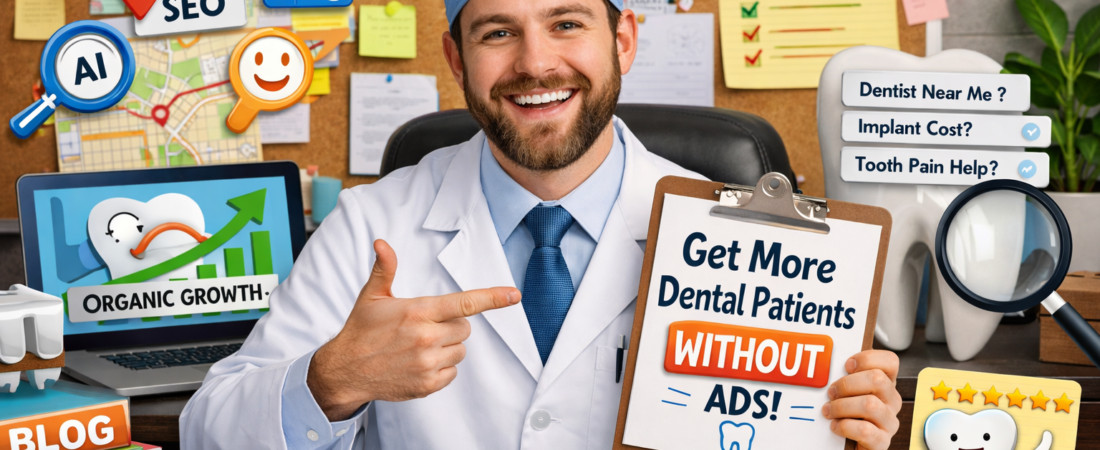
How Dentists Can Get More Patients Without Ads
If your dental practice is wondering how to get more dental patients without ads, you are not the only one. Many dentists are frustrated because they have a decent website, a good team, and quality care, yet their phones are not ringing the way they should. Some have tried ads and felt disappointed. Others have been told to keep boosting posts, spending more money, or waiting for results that never seem to arrive. That is exhausting, and it is one of the biggest reasons dentists start asking whether there is a better way to grow.
There is. Dentists can grow through organic dental marketing strategies that build long-term visibility instead of short-term spikes. Organic growth means your practice shows up when patients search in Google, explore local map results, ask questions in AI tools, or look for answers about symptoms, procedures, insurance, cost, comfort, and trust. It means your content works for you even when you are not running paid campaigns.
This page explains how dentists can build dental lead generation without ads by using better website content, stronger local SEO, AI visibility, a clear content system, and smarter internal linking. The goal is not random traffic. The goal is qualified patient attention from people who are already looking for care.
What It Means to Get More Dental Patients Without Ads
Getting more patients without ads means your dental practice earns attention naturally instead of paying for every click. In other words, patients discover your office because your website, your Google Business Profile, your content, your reviews, and your local signals are strong enough to show up in search results and answer-driven platforms.
This matters because patient behavior has changed. People do not only click on ads anymore. They compare practices. They ask specific questions. They search late at night when they are worried about a symptom. They look for offices that feel trustworthy, experienced, convenient, and relevant to their needs. They also use more natural language when they search. Instead of typing only “dentist near me,” they may search “best dentist for nervous patients near me,” “tooth pain when biting what should I do,” or “how much do dental implants cost in my area.”
That is where organic growth becomes powerful. When your dental website is built to answer these questions and support that search behavior, it becomes easier for both Google and AI-driven platforms to understand what you offer. Organic growth is not a magic trick. It is a structured visibility strategy built on relevance, clarity, consistency, and trust.
Dental practices that build organic visibility create stronger long-term patient flow than practices that rely only on temporary attention.
Key Takeaway: Organic dental marketing helps your practice get discovered by patients who are already searching, comparing, and looking for answers without forcing you to pay for every visit.
Why Ads Alone Are Not Enough for Modern Dental Growth
Ads can be useful in certain situations, but they are not a complete growth strategy. The biggest problem with depending on ads is that they create rented visibility. Once you stop paying, the exposure often disappears. That can leave your practice stuck in a cycle where you must keep feeding ad spend just to maintain the same level of attention.
Another issue is trust. Many patients are cautious. They often trust organic search results, reviews, educational content, and local presence more than a paid placement. A paid ad may get a click, but it does not automatically earn confidence. If the landing page is weak, vague, or generic, that click may go nowhere.
Ads can also become expensive in competitive areas. Dental practices often compete against large groups, aggressive local advertisers, and offices with bigger budgets. That creates pressure. It can also make dentists feel like growth is available only to the highest spender. That is not true. Strong content and local authority can close that gap over time.
Organic dental marketing strategies solve a different problem. They help your practice build lasting relevance. They create a stronger foundation for search visibility, local trust, AI discoverability, and conversion. Instead of depending on interruption marketing, you become part of the information patients are already seeking out.
Dental practices that rely only on ads often experience unstable lead flow. Dental practices that invest in organic visibility create a more durable marketing asset.
Key Takeaway: Ads can help temporarily, but they do not replace the long-term value of strong website content, local authority, and organic search visibility.
The Core Organic Growth Strategies Dentists Should Focus On
If a dentist wants more patients without paying for ads, the answer is not one isolated tactic. It is a system. The strongest organic dental marketing strategies combine several connected pieces that support one another.
Strengthen Your Main Website Pages
Your homepage, about page, service pages, and contact page must clearly communicate who you help, what you offer, where you are, and why someone should choose your office. Many dental websites look attractive but say very little. They are often too general. They mention quality care and friendly teams, but they do not explain enough about services, patient concerns, or what makes the practice relevant to a real search.
Publish Patient-Focused Content
Blogs, FAQs, and service-supporting content help your practice answer real questions and target longer searches. This is important because patients ask highly specific questions before they ever book an appointment. Educational content helps your website meet them earlier in that journey.
Improve Local SEO Signals
Local SEO helps your practice appear when people search in your city, suburb, neighborhood, or nearby area. For dentists, local search is critical because most patients want care close to home or work.
Support Everything With Reviews and Trust Signals
Patients want reassurance. Reviews, before-and-after expectations, comfort messaging, financing details, office photos, and patient-friendly explanations all influence whether a visitor becomes a lead.
Use Clear Calls to Action
Your website should make it easy for visitors to take the next step. That means clear buttons, simple contact options, and page flow that guides readers naturally toward booking or contacting your office.
Key Takeaway: Dentists grow faster when their website acts like a complete patient education and trust-building system, not just an online brochure.
Local SEO for Dentists Is One of the Biggest Drivers of Organic Patient Growth
Local SEO for dentists is the process of helping your practice appear in location-based search results. That includes searches such as “dentist near me,” “family dentist in [city],” “emergency dentist near me,” or “best cosmetic dentist in [area].” These are high-value searches because they often come from people who are actively looking for care.
Your Google Business Profile plays a major role here. It helps Google understand your business category, hours, location, reviews, and service relevance. But a profile alone is not enough. Your website must support it with clear service content, consistent business details, and useful local signals.
That means your service pages should mention the types of patients you help, the treatments you provide, and the local area you serve in a natural way. It also means creating local pages when appropriate, especially if your office draws patients from nearby towns or neighborhoods. A dentist who serves a broader metro area should reflect that in the website structure without sounding repetitive or forced.
Local SEO also improves mobile and urgent-intent performance. Someone searching with tooth pain does not want a generic site. They want a nearby office that looks trustworthy, helpful, and easy to contact. Your content should support that decision. The stronger your local relevance, the greater the chance you appear in the right moment.
Local SEO is not just about ranking. It is about being visible when patient intent is highest.
Key Takeaway: Dentists who strengthen local SEO improve their chances of being found by nearby patients who are ready to compare, call, or book.
Why AI Visibility Matters for Dentists Now
Search is changing. Patients still use Google in the traditional way, but they also use AI tools, voice assistants, and answer engines to get fast information. They ask questions about symptoms, treatment choices, cost expectations, and provider options. This is why AI visibility is becoming part of modern dental growth.
When someone asks an AI platform a question like “how do I know if I need a root canal” or “what should I look for in a dentist for anxious patients,” the platform tries to summarize information clearly. If your content is thin, vague, or poorly structured, it is less likely to support those environments well. If your website is organized, answer-focused, and rich with useful detail, it becomes more understandable to both search engines and AI systems.
This is where AEO and GEO matter. Answer Engine Optimization means structuring content so that direct questions receive direct answers. Generative Engine Optimization means making your content easier for AI systems to interpret, summarize, and surface. Dentists who want stronger AI visibility should use FAQ sections, clear headings, simple definitions, short answer paragraphs, and supporting context throughout the page.
Dental practices that do not publish structured, optimized content will struggle to appear in both Google search and AI-generated answers. That is why AI visibility is no longer optional. It is becoming part of discoverability.
Key Takeaway: AI visibility expands your reach beyond traditional rankings and helps your practice show up where modern patients now ask questions.
Dentists Need a Content System, Not Random Posts
One of the biggest mistakes in dental marketing is publishing content only when there is extra time or a quick idea. Random posts create random outcomes. A dental practice that wants steady organic growth needs a content system.
A content system is a structured plan for publishing pages and posts that align with patient search behavior, service goals, and local visibility. It includes strong service pages, FAQs, supporting blog posts, local pages, internal links, and regular content updates. Each piece supports the next. That creates stronger topical authority and clearer site structure.
For example, if a practice wants more implant cases, the content system might include an implants service page, a page about implant candidacy, a blog about implant cost questions, an FAQ about healing and timing, and internal links pointing toward a consultation page. If the goal is more family dentistry traffic, the system might include pages about cleanings, exams, children’s visits, preventive care, dental anxiety, and insurance questions.
When content is connected in a thoughtful way, it helps search engines understand your authority. It also helps patients continue learning. A person who lands on a blog about tooth sensitivity can click into a general dentistry service page. A reader learning about cosmetic options can move into veneers or Invisalign content. This is how content supports both SEO and conversion.
A dental content system turns your website into a visibility engine instead of a collection of disconnected pages.
Need help building a dental content system? Visit our services page to see how strategic page planning, SEO content, FAQ content, and AI-ready optimization can support your growth.
What Content Helps Dentists Generate Leads Without Ads?
If your goal is dental lead generation without ads, the content on your website should match the questions patients ask before they choose an office. It should also reflect the services you want to grow and the areas you want to reach.
Service Pages
Every major dental service should have a dedicated page. That includes family dentistry, cosmetic dentistry, Invisalign, dental implants, emergency dentistry, pediatric dentistry, dentures, crowns, root canals, and more if relevant to your practice. These pages help patients understand options and help search engines connect your office to service-related searches.
FAQ Sections
FAQ content is especially powerful for AEO and GEO because patients search in question form. Questions like “How much does Invisalign cost,” “Can a tooth infection go away on its own,” or “Is a dental crown painful” can be answered clearly in structured sections that are useful to both readers and search engines.
Blog Content
Blogs help your website target long-tail questions and broader educational topics. They support trust and topical depth. A blog post can bring in traffic earlier in the patient journey and then guide the visitor into a service page or contact action.
Location Pages
If your office serves multiple nearby communities, location pages can help strengthen local relevance when they are written well and provide real value.
Trust and Comfort Content
Pages about your office approach, sedation options, financing, first visits, comfort care, and patient experience can help reduce hesitation and improve conversion.
Key Takeaway: The best dental websites do not just promote services. They answer concerns, reduce uncertainty, and guide patients toward action.
What Most Dental Websites Get Wrong
Many dental websites are not underperforming because the office is bad at dentistry. They are underperforming because the content is too weak to compete. Some websites use generic language that sounds exactly like dozens of others. Some rely on very short service pages. Some have almost no FAQ content. Others lack internal links, clear local relevance, or keyword depth.
A site can look modern and still fail to rank or convert. Patients need clarity. Google needs context. AI systems need structure. If the site does not explain services, answer questions, or support trust, it becomes harder to surface in search and harder to turn visitors into leads.
Another common problem is duplicate or overused agency content. If many practices are using similar wording, that content is less distinctive. Strong dental content should sound specific, useful, and tailored to the patient journey. It should also align with what real people search, not just what sounds nice in a brochure.
The dental practices that win organic visibility usually have stronger content, clearer structure, and better trust-building signals than the competition.
Key Takeaway: A dental website should not only look professional. It should educate, reassure, organize information clearly, and make the next step easy.
How Internal Linking Supports SEO, AEO, GEO, and Conversions
Internal linking is one of the easiest and most overlooked ways to strengthen a dental website. Internal links connect one page of your site to another. This helps search engines crawl your content, understand page relationships, and recognize topic depth. It also helps users move naturally through your website.
For example, a blog post about “how dentists can get more patients without ads” can link to your services page, your contact page, your local marketing pages, or related blog posts. A service page for dental implants can link to financing content, FAQ content, and consultation pages. These links improve structure and help distribute authority throughout the site.
Internal linking also supports AEO and GEO because it creates clearer semantic relationships. It shows how topics fit together. A well-linked site is easier for both Google and AI systems to understand. It also helps readers continue exploring instead of bouncing away after one page.
Internal linking is not just a technical SEO task. It is part of the user experience and part of the site’s authority structure.
Want better site structure and stronger content flow? Explore our blog for more dental marketing guidance, or go to our contact page to talk about improving your dental website strategy.
Frequently Asked Questions
How can dentists get more patients without ads?
Dentists can get more patients without ads by improving local SEO, strengthening service pages, publishing blog content, answering patient questions clearly, optimizing for AI visibility, building review signals, and using internal linking to support site structure.
What are the best organic dental marketing strategies?
The best organic dental marketing strategies include local SEO, Google Business Profile optimization, content marketing, FAQ creation, service page optimization, review generation, schema markup, and AI-ready website content.
What is dental lead generation without ads?
Dental lead generation without ads means attracting patient inquiries through unpaid channels like organic search, local map visibility, educational content, strong website pages, and patient trust signals.
Do blog posts really help dentists get more patients?
Yes. Blog posts help dentists target long-tail keyword phrases, answer search questions, support SEO, improve AEO and GEO value, and guide visitors toward service pages and appointments.
Why is local SEO important for dentists?
Local SEO is important because most patients want a nearby provider. Strong local signals help your practice appear when people search for dentists, symptoms, and procedures in your city or surrounding area.
Why is AI visibility important for dentists now?
AI visibility matters because patients increasingly use AI tools and voice-based search to ask questions about dental care. Practices with clear, structured, answer-focused content are more likely to be surfaced in those experiences.
How does schema help a dental website?
Schema helps search engines understand your page content more clearly. Article schema, FAQ schema, and organization schema can improve clarity, support rich results, and strengthen how your content is interpreted across search environments.
How does internal linking help my dental website?
Internal linking helps users find related pages, improves crawlability, strengthens topical relevance, and supports conversions by guiding visitors from educational pages to key action pages.
Final Thoughts: Dentists Can Grow Organically Without Depending on Ads
Dentists absolutely can grow without relying on paid advertising, but the path is not passive. It takes a stronger content strategy, better local SEO, clearer service pages, more useful FAQ content, and a website that is built to support how people search now. It also takes understanding that SEO alone is no longer the whole story. AEO and GEO matter because patients increasingly look for answers through AI tools, voice search, and summarized search experiences.
The dental practices that will have an advantage are the ones that build useful, structured, readable content that addresses real patient questions. They will also be the practices that strengthen internal linking, local relevance, trust signals, and content depth. These things work together. They help Google understand your site. They help AI systems interpret your content. They help patients feel more confident about contacting your office.
Organic growth is not about chasing vanity traffic. It is about building the kind of online presence that attracts qualified patient attention again and again over time. If your practice wants to get more patients without ads, the answer is not to do less marketing. The answer is to build smarter visibility that keeps working long after a paid campaign would have ended.
Ready to improve your website content for SEO, AEO, and GEO? Visit our services, read more on the blog, or go straight to the contact page to start improving your dental content system.